Distance vs Accuracy in Golf: How Mid-Handicaps Really Lower Scores Faster
Every golfer eventually faces this question: Should you focus on hitting the ball farther, or keeping it straighter?
For mid-handicap golfers, the answer isn’t always as simple as “one or the other.”
The real truth is that distance and accuracy don’t matter equally for every golfer, and they don’t help your score in the same way.
The more consistent your swing becomes, the more distance and accuracy can work together instead of competing for attention.
This guide breaks down what the data really says about distance vs accuracy, how age and ability affect the equation, and how to know which one you should be working on.
Distance vs Accuracy in Golf (Key Takeaways)
- Most mid-handicaps gain more from added distance than slightly better accuracy as long as the ball stays in play.
- Accuracy becomes the priority when your misses lead to penalty strokes, punch-outs, or total “disaster holes.”
- Golfers 45+ benefit most from: a moderate increase in speed, and much stronger face control to manage dispersion.
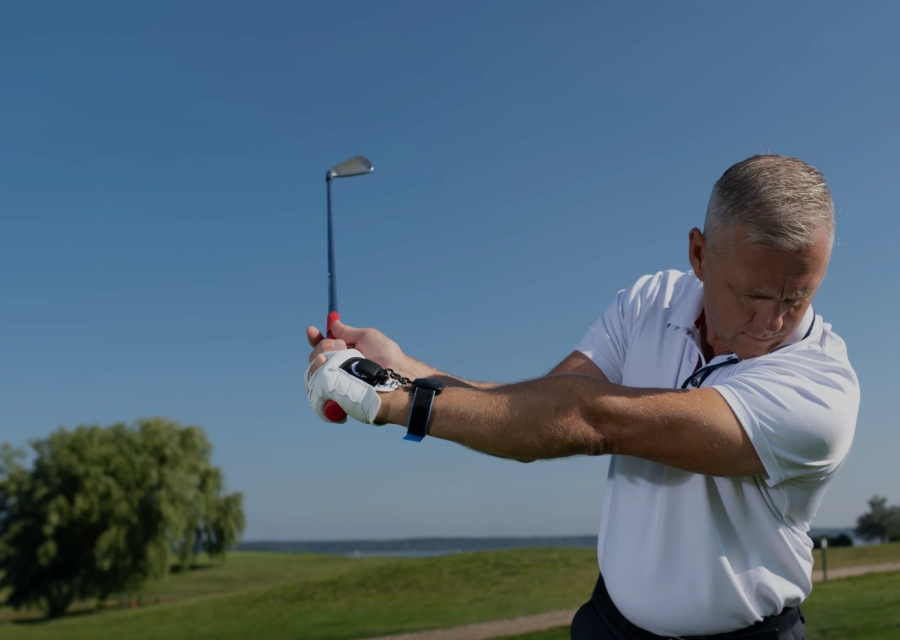
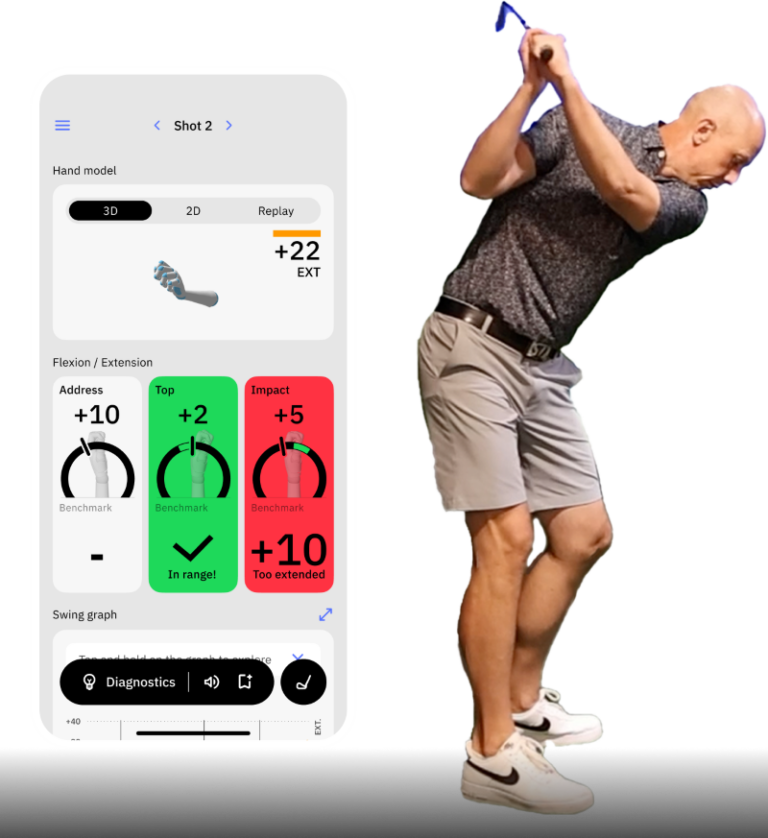
- Wrist mechanics control the clubface and the delivered loft, which means they directly control both distance and accuracy.
Contents
Distance vs Accuracy: What the Numbers Really Say
Before we get into the how-to, we took a look at various sources, including some from Shot Scope, TrackMan, and Arccos, to collect data on distance vs. accuracy.
Here’s what they all agree on:
Distance Helps More Until it Starts Hurting You
- Adding 10–20 yards off the tee increases GIR percentage dramatically.
- Shorter approach shots lead to better proximity, fewer three-putts, and more scoring chances.
- Arccos shows that distance improvements often add 1–1.5 strokes gained per round, while improving fairway percentage only adds 0.2–0.3 strokes for most mid-handicaps.
Accuracy Becomes More Valuable When Misses Get Destructive
When you start hitting balls in trees, taking penalty strokes, and getting blocked behind obstacles, accuracy certainly becomes more valuable. If your misses are a near miss on the fairway, the impacts are not as severe.
Once your misses cross into “recovery-mode golf,” accuracy beats distance every time.
Golfers 45+ Face a Different Equation
With age, swing speed naturally declines. That means:
- Distance becomes more important just to reach the greens.
- But accuracy becomes more important because wild misses are harder to recover from.
This is why wrist mechanics matter so much at this stage. If you can control the clubface, you’ll hit fewer destructive shots, and you can safely add speed on top of that.
Which Should You Work On Right Now?
Now that you’ve seen the issues with both accuracy and distance, you likely have an idea as to which one you struggle with the most.
The path to improvement is slightly different depending on if you are trying to add accuracy or distance. Start here:
If You Think Distance is Your Problem
If you have distance issues in your golf game, you probably notice some of the following:
- You’re always hitting hybrids or long irons into greens.
- Par 4s feel longer than they should.
- You make solid contact, but the ball just doesn’t go.
- You often need three shots to reach long par 5s.
- Your driver has a low, spinny flight that never carries far.
| What You’ll See on the Course | What You Need to Work On | Drill to Use |
|---|---|---|
| You can’t reach long par 4s in two | Bigger turn + wider hand path | Top Drill |
| Good contact but low, spinny drives | Stronger lead wrist position at the top | Motorcycle Drill |
| You “throw” the club early, losing lag | Later release and better sequencing | Casting Drill |
| You feel like you’re swinging hard but not generating speed | More efficient transition and body rotation | Release Drill |
If You Think Accuracy is Your Problem
Accuracy issues show up as inconsistency. Some holes feel easy, and others feel unplayable. Common signs include:
- You hit some great drives… and some that you immediately regret watching.
- Your driver has a two-way miss (start left AND start right).
- You find hazards, trees, or OB multiple times a round.
- Irons are decent, but your driver is unpredictable.
- You can’t control where the club bottoms out, thin and fat shots show up too often.
Accuracy issues almost always come from poor clubface control, not alignment or tempo. And face control is driven by wrist mechanics, especially the lead wrist.
| What You’ll See on the Course | What You Need to Work On | Drill to Use |
|---|---|---|
| Big slice or hook when you swing harder | Better lead wrist control in transition | Motorcycle Drill |
| You miss both left and right | Consistent lead wrist angle early in backswing (P2) | P2 Wrist Check Drill |
| Lots of thin or fat shots | Low-point consistency + stable wrist through impact | Low Point Line Drill |
| Driver is wild, but irons are OK | Matching wrist patterns between irons & driver | Motorcycle + P2 Combo |
Want a deeper dive into fixing dispersion and tightening your accuracy?
Check out our guide on how to square the clubface.
Accuracy and Distance Drills
These HackMotion drills will help with both distance and accuracy.
Use the tables above to find the issue you need to work on and practice these drills to improve your performance.
Top Drill
Top Drill – Step by Step:
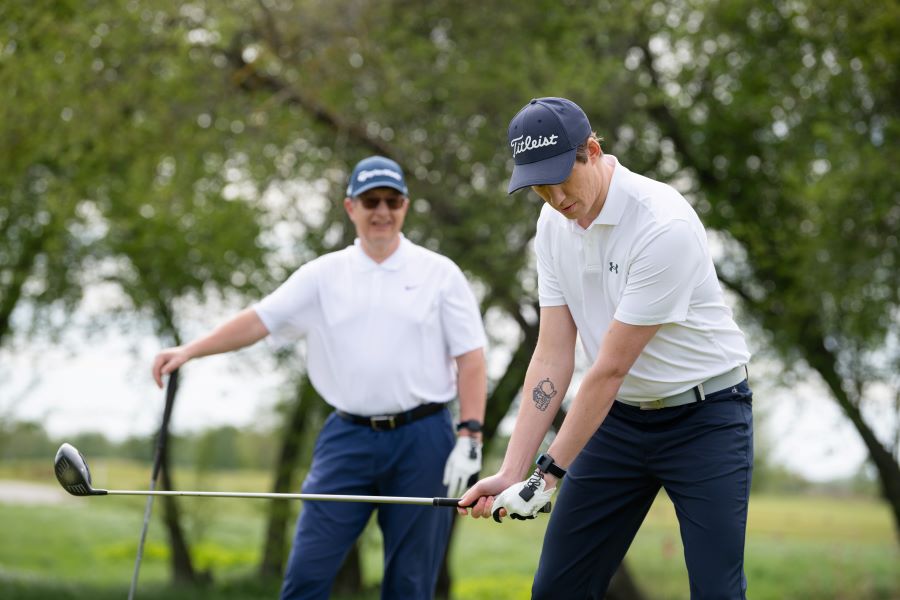
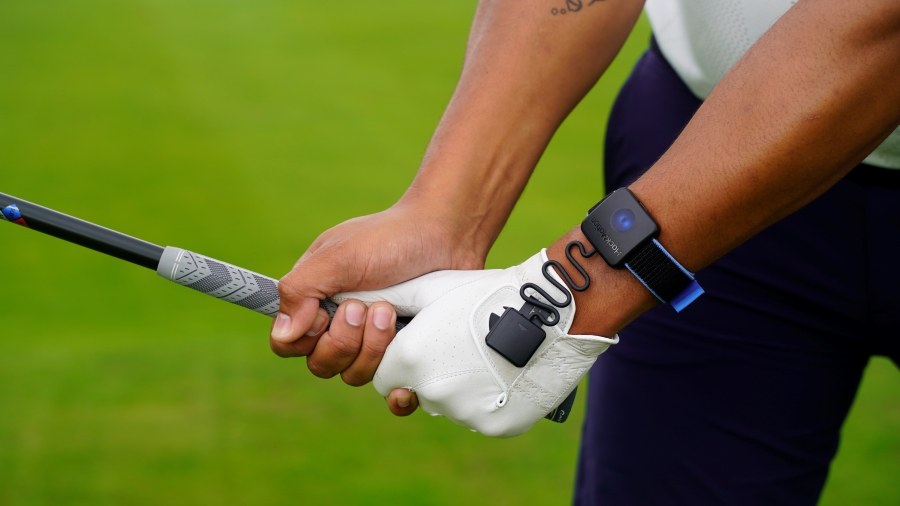
- Make your normal setup with HackMotion on.
- Take a full backswing, emphasizing chest rotation.
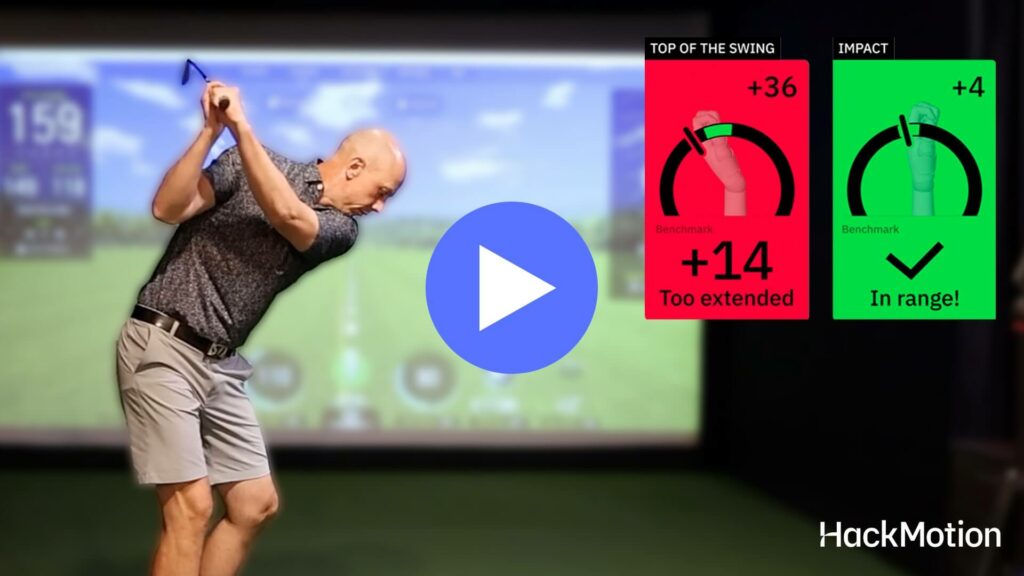
- Pause and check wrist angles at the top, specifically look for no excessive extension.
- Repeat until full turn and strong wrist position feel natural.
Release Drill
Release Drill – Step by Step:
- Swing to waist-high, then start down with your body, not your hands.
- Feel the club “lag” and release naturally at the bottom.
- Watch HackMotion for a smooth flexion – extension pattern through impact.
Motorcycle Drill
Motorcycle Drill – Step by Step:
- Take the club to the top.
- Start down by “revving” your lead hand like a motorcycle.
- This adds flexion and squares the face earlier.
- Hit half shots while keeping extension down on HackMotion.
P2 Wrist Check Drill
P2 Wrist Check Drill – Step by Step:
- Take the club back until the shaft is parallel to the ground.
- Pause and check wrist angle—avoid early extension.
- Repeat until the motion becomes automatic.
Casting Drill
Casting Drill – Step by Step:
- Take your normal setup with HackMotion on.
- Swing back to waist height, keeping the wrists relaxed.
- Start the downswing by shifting pressure into your lead side — without throwing the clubhead.
- Feel the club “trail” behind your hands as your body rotates.
- Keep the lead wrist from adding extension too early (watch this on HackMotion).
- Let the club release naturally at the bottom, not from the top.
- Hit soft to mid-speed shots, focusing on later release timing and a more compressed strike.
Low Point Line Drill
Low Point Line Drill – Step by Step:
- Draw a line on the ground.
- Place the ball slightly ahead of it.
- Hit shots making the divot start in front of the line every time.
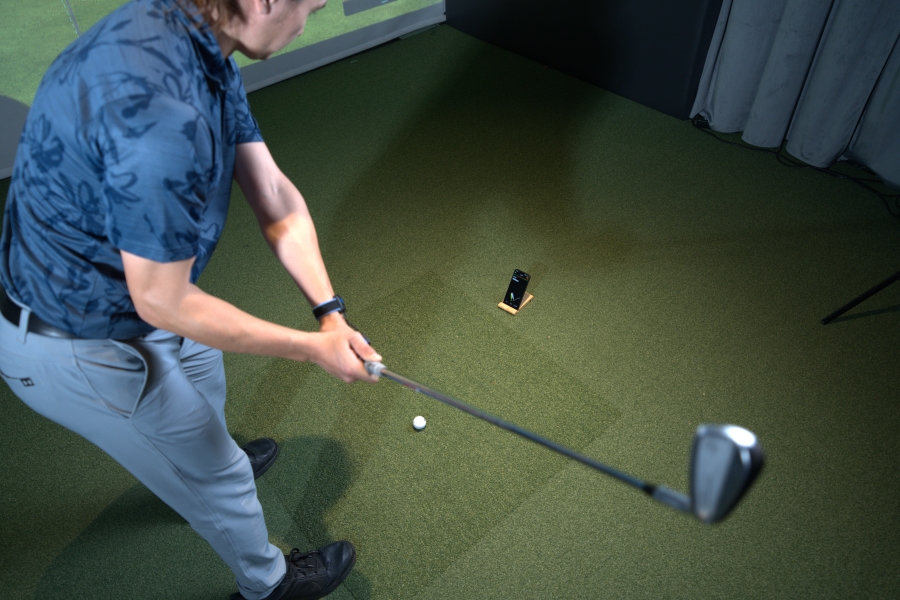
- Use HackMotion to watch your lead wrist stabilize through impact.
When to Choose Distance vs. When to Choose Accuracy (On the Course)
Distance and accuracy aren’t just things you train on the range; they’re decisions you make on nearly every tee box and approach shot.
Smart golfers know when to pick the conservative line and when an aggressive, distance-first shot actually lowers scoring more. The difference often comes down to the hole layout, the hazards, and how your swing is behaving that day.
Use the table below to understand some situations where you will choose the accuracy or the distance shot on the course.
| Choose Accuracy When… | Choose Distance When… |
|---|---|
| Water/OB guards your typical miss | Landing zone is wide and forgiving |
| Tight, tree-lined fairway | Fairway opens up the farther you go |
| You don’t trust your swing in that moment | You feel confident in your shot shape |
| Long = dead on the approach | You need extra carry to clear trouble |
| Ball is on an awkward lie | Ball is sitting perfectly |
| Wind exaggerates your curve | Wind is neutral or downwind |
| A big miss brings a “double or worse” into play | Hole is long, and the distance gives you scoring potential |
| Safe tee shot sets up a simple next shot | Extra distance sets up an aggressive scoring opportunity |
Want personalized help improving your distance and accuracy?
Use our directory to find a golf instructor near me who understands wrist mechanics and modern swing data.
Final Thoughts
If you’re looking for a true winner, distance generally wins – as long as your misses stay playable. Mid-handicaps, especially golfers 45 and older, gain more from adding a bit of speed than from tightening dispersion by a few yards.
But the moment those extra yards start producing penalty shots or unpredictable curves, accuracy becomes the priority.
The simple rule is this: if you usually stay in play but come up short, focus on distance; if you regularly lose balls or find trouble, accuracy should come first.
HackMotion ties the two together by improving wrist mechanics, helping you build the blend of speed and face control that creates playable distance, the combination that actually lowers scores.