Golf Shots Inside 100 Yards: Practical Tips and Drills That Build Confidence Fast
Most golfers understand that shots inside 100 yards are vital. However, the challenge isn’t recognizing their importance; it’s having a reliable plan for playing them well.
Without clear yardages, consistent technique, and smart club choices, this part of the game can feel unpredictable.
With a few adjustments and a structured approach, you can turn these shots into true scoring opportunities. This guide walks you through how to handle different distances, choose the right club, simplify your technique, and correct common mistakes before they turn into bogeys.
You’ll also find targeted drills designed specifically for wedge play, so you can practice with purpose and build confidence from the scoring zone.
Contents
Golf Shots Inside 100 Yards (Key Takeaways)
Review these key points to start your journey to improve your shots inside 100 yards. This is the key to lower scores that all professionals and experienced golfers already know about.
- Start with a plan based on your comfort level, personal swing habits, and yardages.
- Solidify your technique so each swing is fundamentally sound.
- Know when and how to choose the right club based on all relevant factors.
- Learn how to control your swing with each club so that no distance is uncomfortable for you.
- Address, diagnose, and cure common mistakes on the spot with the handy chart below.
Since these shots show up on almost every hole, having a clear plan for them is essential. Here’s how to approach each one with purpose.
Step-by-Step Plan for Shots Inside 100 Yards
Every wedge shot under 100 yards deserves a simple, repeatable process. Use these four steps to choose the right shot and commit to it.
1. Get Your Landing Yardage
- Measure to the spot where you want the ball to land, not the flag.
- Factor in rollout based on the green firmness and slope.
2. Assess the Lie
- Check whether the ball is in fairway, rough, or a tight lie.
- Note outside factors: wind, elevation, moisture, sidehill lies.
- Adjust expectations—your lie determines how much spin and height you can realistically create.
3. Identify Trouble (Then Shift Your Focus)
- Quickly locate bunkers, short-sided pins, false fronts, or thick rough.
- Once you know what to avoid, place full focus on your safe and smart target.
- Commit to the target that gives you the best chance to hit the green and leave an easy putt.
4. Visualize the Trajectory
- Picture the shot’s height, shape, and landing spot.
- Use the mental image to build confidence and simplify the motion.
- The clearer the visual, the easier it is for the body to execute the swing.
Technique Fundamentals to Master
Good mechanics lead to reliable, crisp strikes and optimal trajectories. Focus on sound fundamentals, which are especially crucial at less-than-full swing speeds.
Setup
- Narrow stance for more control.
- Ball in the middle or slightly back in stance.
- 60–70% weight on the lead (front) foot.
- Stand a bit closer to the ball than on full shots.
Swing Fundamentals
- Maintain body rotation, not just arms.
- Use an abbreviated backswing to control distance.
- Accelerate through impact, avoiding deceleration.
- Optimize wrists on the downswing and through impact.
- Pause at the top to maintain rhythm and tempo.
- Hold the finish for balance and feedback.
Struggling to maintain control and feel with your wedges?
Learn how proper wrist mechanics affect your short game with our Wrist Mechanics for Short Game guide.
How to Pick the Right Club for Golf Shots Inside 100 Yards
You have many clubs at your disposal when dealing with shots under 100 yards. Advanced golfers don’t have a “go-to” club because they know that the conditions are never the same.
Each shot should be carefully evaluated before deciding which club to use.
Below is a guide to using each club effectively, based on their strengths and weaknesses.
Pitching Wedge
Pitching wedge is great for situations where you have some green to work with, and you don’t need a lot of height. Use this club for distances between 65 and 100 yards and expect less spin.
It’s perfect for when you need to approach a green into the wind.
Gap Wedge
Use this club as the name suggests. If you think your pitching wedge is too strong but your sand wedge won’t be enough, fill the gap with your gap wedge.
It provides more height and spin than your pitching wedge but less spin than your sand wedge, so expect a bit of roll out.
Sand Wedge
Use this club when your landing area is more precise. You can use the height to drop a shot precisely where you want it to and have it stick.
Try to avoid using this club into the wind as it will add backspin and cause your shots to come up disproportionately short.
Lob Wedge
The lob wedge is best reserved for special scenarios where green space is at a premium.
If you find yourself short-sided or need to attack a pin that is cut on the front edge of the green, then take advantage of the height and lack of roll that a lob wedge provides. Keep in mind this is a lower-percentage shot, so use it only when necessary.
Partial Swings with 9 or 8 Iron
Some cases may call for even less height on your approach shots, so keep your mind open to the fact that a 9 or 8 iron might be your best option.
This is most likely in strong wind or when a pin is cut on the front of the green, and there is ample room to roll your approach shot up the green.
Want to handle tricky or fast greens with more confidence?
Check out our guide on Mastering Difficult Greens for smart strategies on approach and spin control.
Example of each club distance:
| Club | Full Swing (Yards) | ¾ Swing (Yards) | Half Swing (Yards) |
|---|---|---|---|
| PW | 100 | 80 | 60 |
| GW | 90 | 70 | 50 |
| SW | 75 | 60 | 45 |
| LW | 60 | 45 | 35 |
How to Consistently Hit the Right Yardages Inside 100 Yards
Knowing the number is one thing. Being able to hit that number on demand is the real key and for most amateurs the missing piece.
The quickest way to build real distance control is to create three predictable wedge shots with each club instead of guessing somewhere between full and half swings.
Use this simple 1–2–3 system with your sand wedge (and then your other wedges).
Shot 1: Short Pitch (Thumbs Down, Close Setup)
This is your shortest, most controlled shot.
- Stand closer to the ball (about 1–3 clubhead widths away).
- Keep the ball near the center of your stance with a little shaft lean.
- Feel like your thumbs stay “pointing down” toward the ground in both the backswing and follow-through.
- Turn your torso to move the club instead of overusing your hands and arms.
This creates more of a “Y” shape between your arms and the club, keeps the radius consistent, and makes clean contact easier. On the range, hit a series of these and write down how far they actually fly.
Shot 2: Mid-Distance Wedge (Towel Drill + Thumbs Up)
This is your medium carry distance.
- Stand a little farther from the ball and widen your stance slightly.
- Place a towel under both arms to keep your arms connected to your body.
- Let the wrists hinge more so the swing feels like an “L-shape to L-shape.”
- Feel your thumbs “point up” toward the sky in both the backswing and through-swing.
The added wrist hinge creates more speed and height without losing structure. This becomes your go-to mid-range wedge shot.
Shot 3: Full-Swing Feel at 70–80% Speed
This is your longest controlled wedge, just under a full swing.
- Take your normal full-swing setup with that wedge.
- Make a full backswing and full follow-through.
- The only change: swing the whole motion at about 70–80% speed with a smoother rhythm.
You’re essentially hitting a “soft full” shot. Over time, this gives you a predictable top-end distance that doesn’t feel like you’re swinging out of your shoes.
Common Mistakes (and How to Fix Them)
Many amateurs struggle inside 100 yards, but awareness and the proper corrective drills can quickly yield lower scores.
| Fault | Cause | Fix/Drill |
|---|---|---|
| Decelerating swing | Fear of going long, lack of trust | Shorter backswing and swing through to a full finish |
| Flipping wrists/scooping | Trying to lift the ball for more height | Focus on forward shaft lean and flat lead wrist |
| Chunking/fatting shots | Poor weight shift | 60%+ weight front foot |
| Thinning/skulling shots | Looking up too soon, ball too far forward | Steady head/balance, mid-stance ball |
| Overcomplicating club selection | Too many options, no practice routine | Build and use a wedge yardage matrix (see above) |
Drills to Hit More Accurate Shots From Inside 100 Yards
Learning how to control your shots from inside 100 yards will take your game to a new level, and these drills are specifically designed for the task.
Ready to put these tips into a structured routine?
Use our Short Game Practice Plan to build consistency and confidence with every wedge shot inside 100 yards.
Towel Under Arms Drill
Using your body and bigger muscles is the best way to control distance. Your torso movement is more reliable than trying to adjust using just your arms.
However, most golfers start their careers with this nasty habit, so use this drill to incorporate your body more and let your arms relax.
- Video Timestamp: 3:34 – 7:17
Towel Under Arms Drill – Step by Step:
- Stretch a golf towel across your chest, with each end tucked under your arms.
- Take half-swings using your torso while keeping the towel in place.
- This keeps your arms connected to your body.
- Hit shots to a predetermined target and maintain consistent distance.
Eliminate Casting Drill
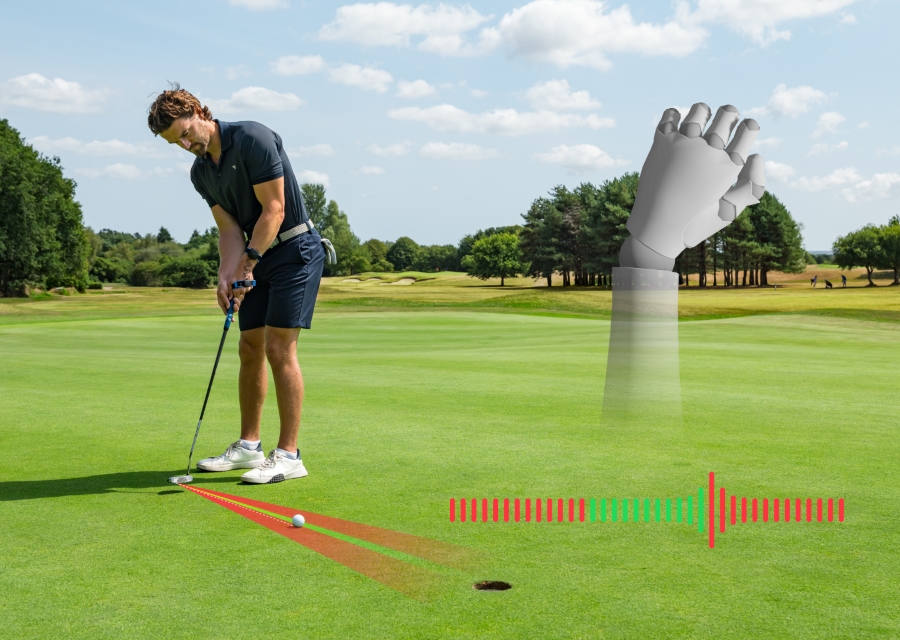
The HackMotion system comes with specialized drills designed to help you get in the correct position for all types of shots.
While this drill will help with all full swing shots, you’ll see a huge difference in your ball striking with shorter shots, where contact is paramount.
- Video Timestamp: 3:53 – 6:52
Eliminate Casting Drill – Step by Step:
- Address a ball with your Hackmotion to calibrate the system and prepare to hit and record the shot.
- Follow the on-screen prompts that will ensure you’re in the correct setup position.
- Once you get the green screen of approval, the app will prompt you to set your wrists without moving any other part of your body.
- Once you see the green screen again, you can move on to the next stage, which is a proper backswing and top of the swing position.
- From here, you can either initiate your downswing in slow motion to ensure you’re doing everything correctly or swing at full speed and hit the ball. Either way you choose, the Hackmotion sensors will track your movement and let you know if you get out of position.
Ball Compression Drill
This is another ball-striking drill that, when used with HackMotion, can also become a technique drill. It teaches you proper weight transfer, wrist position, tempo, and swing plane.
You can also use this drill as part of a well-balanced warm-up routine before rounds.
- Video Timestamp: 1:03 – 3:44
Ball Compression Drill – Step by Step:
- Lay down a small golf towel about eight inches behind your ball.
- Hit shots to a predetermined target without hitting the towel.
- If the drill is too easy, then move the towel closer to the ball.
- Always hit to a target inside 100 yards, but use different clubs to gain more experience and the ability to adapt to different yardages.
Final Thoughts
Shots from inside 100 yards are critical to shooting great scores. Being comfortable from these distances will help you make more birdies and get yourself out of trouble when bad tee shots happen.
Using the information above, you can lock down these shots and get your game to a new level.
When used in conjunction with HackMotion, you’ll see results quickly that will help lower your handicap and increase your enjoyment of the game. After all, making birdies is more fun than making bogeys.
Need personalized guidance on improving your wedge play inside 100 yards?
Find a HackMotion-verified golf coach who can analyze your technique and help you hit more consistent scoring shots.