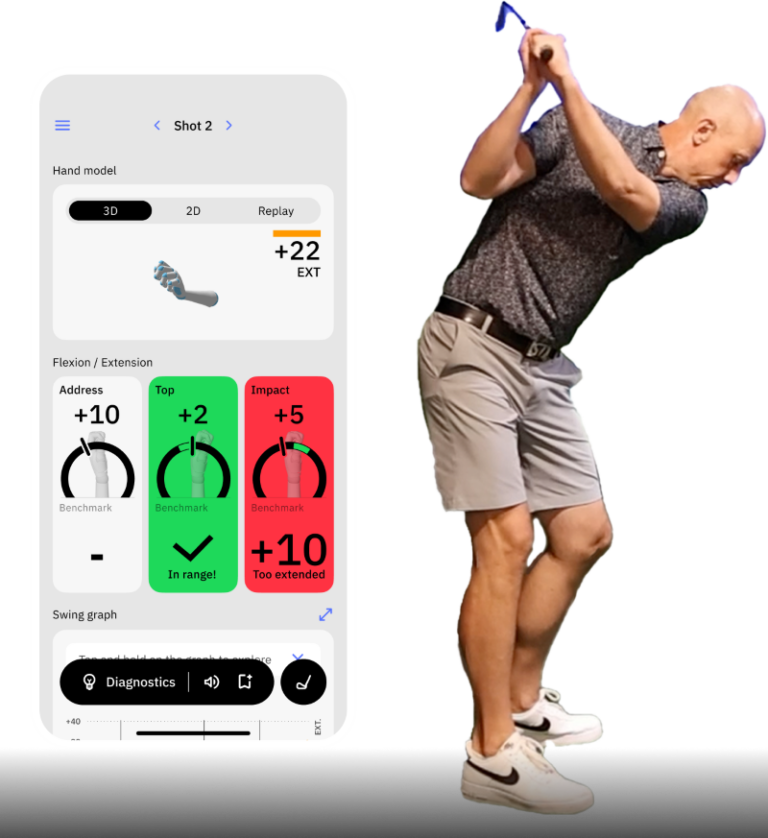
The Laid-Off Golf Swing Explained (And How to Get Back on Plane)
While a laid-off golf swing may look harmless, it causes big problems, including weak fades, surprise hooks, and inconsistent contact.
A swing is considered “laid off” when the club points left of the target at the top instead of staying parallel, and it usually stems from an inside takeaway or incorrect wrist action.
It’s one of the easiest swing faults to diagnose and fix once you know what’s causing it.
Below, we’ll break down why it happens, how it affects your ball flight, and the simple adjustments and drills (including HackMotion wrist checkpoints) that get your club back on plane.
Laid-Off Golf Swing (Key Takeaways)
- Start the club straight back, not inside. Keep the clubhead outside your hands for the first foot of the takeaway to avoid getting laid off immediately.
- Set up taller with a neutral grip. This prevents the low, around-the-body takeaway that pushes the shaft left at the top.
- Keep the lead wrist slightly extended in the takeaway. Too much early bowing (flexion) pulls the club inside and shuts the face—HackMotion makes this easy to measure.
- Match your body turn to your arm swing. Under-rotating traps the arms behind you; over-rotating forces the shaft flat and laid off.
- Recenter your swing path. Move away from an exaggerated in-to-out move and return to a more neutral approach into impact.
Contents
What is a Laid-off Golf Swing?
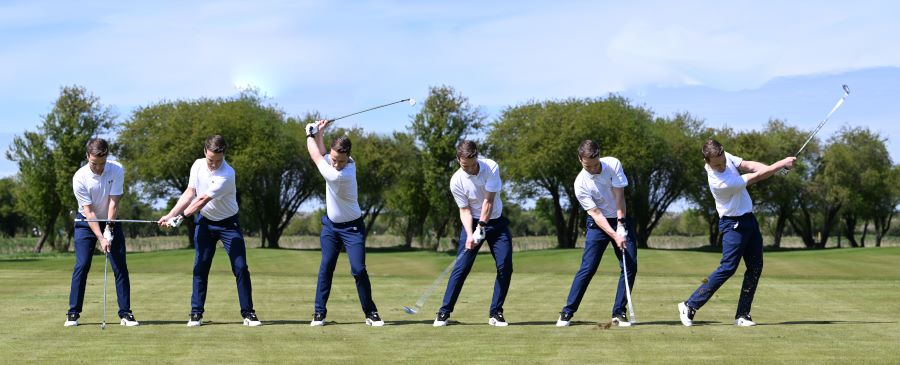
A ‘laid-off’ golf swing refers to the position of the club at the top of your backswing when the club shaft points left of your intended target line (for right-handed golfers), rather than parallel to it.
Imagine looking at yourself from behind, staring down your target line: at the very top of your swing (shaft parallel to the ground), the club is aimed left instead of straight toward the target.
This usually happens when you swing the club too far inside on the takeaway or hinge your wrists incorrectly.
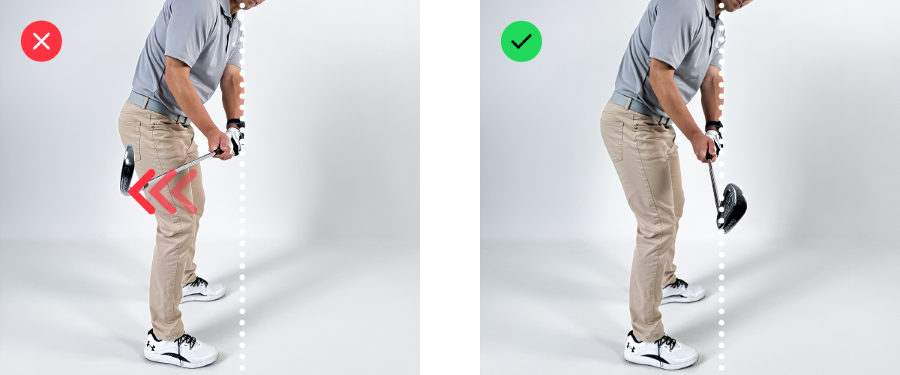
The “laid-off” position can make it harder to control the clubface, often leading to weak fades or vicious hooks.
While some top professionals use a slightly laid-off position effectively, for most newer golfers, it can introduce timing and consistency issues, making it more difficult to hit solid, straight shots.
| Swing Type | Club Position at Top (for right-handed golfers) |
|---|---|
| On-plane | Club points parallel to the target line |
| Laid-off | Club points left of the target line |
| Across-the-line | Club points right of the target line |
Why Does the Laid-off Position Happen?
Here is how you can identify if you have a laid-off swing. Keep in mind you could be doing any combination of these traits, which will compound any minor mistakes.
Try to be as honest with yourself as possible.
Poor Takeaway Mechanics
A laid-off swing primarily starts with a takeaway that is too inside.
Instead of extending the club head backwards along the extended target line, a laid-off swing brings the club head directly inside as it moves away from the ball.
Early Wrist Cupping
Monitor your wrist action with Hackmotion or a mirror to ensure your lead wrist is flat or slightly bowed.
This will help correct a closed clubface, which is common with laid-off swings.
Over-Rotating Forearms
The body usually leads too much with a laid-off swing, which causes the forearms to get left behind.
To catch up, they rotate hard at the ball, which is difficult to sync with a good tempo.
Incorrect Body Rotation
Either rotating too much or not enough could cause a laid-off swing.
Too much rotation gets the body ahead, forcing a flatter shaft on the downswing.
Not enough rotation puts all the pressure on the arms and limits the backswing, so the club can’t get into the correct position.
Excessive Flattening of Swing Plane
Simply flattening the swing to overcompensate for a slice is also very common.
The hands stay low and inside during the backswing, then swing too much around the body on the downswing. Not all flat swings are laid off, but it is in most cases.
How to Fix a Laid-off Golf Swing (Step-by-Step)
Fixing a laid-off swing starts with correcting the pieces that create it—your setup, takeaway, wrist action, and swing path.
These four steps build on each other so you can move the club back on plane and keep it there without having to manipulate it on the way down.
Follow them in order for the quickest and most consistent results.
1. Pre-Swing Adjustments
- Stand up a bit taller and a bit closer to the ball. This will help you take the club away along the extended target line and not inside.
- Neutralize your grip by keeping your hands more on top of the handle. This prevents your wrists and forearms from over-rotating.
- Allow your weight to favor your lead side. Leaning back makes it easy for your body to create a laid-off swing.
- Take a narrower stance to allow your body to rotate more and easily reach the top of the swing.
2. Optimize Wrist Movement
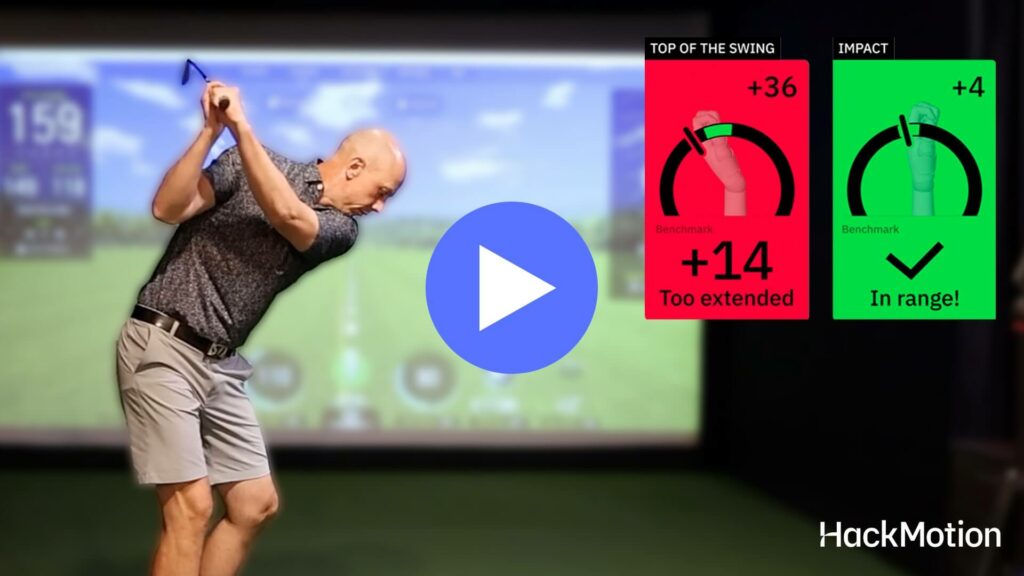
At address, keep your lead wrist slightly extended (flat or just a bit cupped). Maintain that feel in the takeaway so the clubface stays neutral instead of rolling inside.
Too much early bowing closes the face, pulls the club behind you, and puts the shaft in a laid-off position by halfway back.
When the shaft reaches hip-high, your lead wrist should still feel flat or slightly extended, and the clubface should be close to vertical, not pointed at the ground.
HackMotion makes this easy to verify by showing whether you’re adding flexion too early. If the graph spikes early, focus on keeping a touch more extension through the takeaway.
Want to dive deeper into wrist mechanics and how they influence your swing plane?
Check out our guide on wrist action in the golf swing to solidify your takeaway and impact positions.
3. Control the Swing Path
Many golfers who have a laid-off swing do so because they’re compensating for a closed clubface by swinging more in-to-out, or to the right. If this adjustment isn’t timed exactly, it leads to further problems.
If you continue swinging excessively to the right and simply open the clubface, you’ll notice more pushes and gentle draws instead of severe hooks.
This is an improvement, as you’re eliminating the extreme combination of a closed face and a pronounced in-to-out path.
However, your goal is to achieve a more neutral position at the top of the swing and a clubface angle that isn’t excessively closed relative to that path.
4. Swing Aids
Utilizing certain training aids will help your body get into the correct position throughout the swing.
Sometimes all it takes is the careful placement of a headcover to realign your swing path. While other times it may take advanced technology like HackMotion or video review.
If you use these from the start, then you will speed up your learning curve. But be sure you select the correct training aid that addresses your specific issue.
- Alignment sticks to govern your backswing and downswing.
- Hackmotion to monitor wrist action and tempo (especially the HackMotion Takeaway drill).
- Mirror to see results in real time.
- Headcover or towel to keep your swing path on plane.
Drills to Correct Your Laid-Off Swing
These drills will address your laid-off swing directly by curing the most common issues.
There is a drill below for swing path, wrists, and swing plane. You can focus on one or use all three to ensure your swing works as a unit.
Swing Path Check Drill
Use this drill to prevent a downswing that comes from the inside too much. Leading with the hands keeps the club flat, which is a common trait of laid-off swings.
Doing this drill in slow motion trains your body to approach the ball on a neutral swing path.
- Video Timestamp: 5:01 – 6:10
Swing Path Check Drill – Step by Step:
- Lay down an alignment stick between your feet and the ball. This represents your target line.
- As you start your downswing, stop when your club is parallel to the ground and check the clubface in relation to the alignment stick on the ground.
- The grooves and leading edge of your club should be perpendicular to the alignment stick.
- If your swing is laid off, you’ll see much more of the clubface as it will be much more open to the sky.
Set The Wrists Drill
Get a great understanding of what your wrists should feel like with this drill.
You can do it with an alignment stick on the ground or rely on the advanced sensors and accompanying app that pair with the Hackmotion system.
Using Hackmotion will guide you every step of the way to keep your wrists aligned from start to finish.
- Video Timestamp: 1:03 – 4:31
Set The Wrists Drill – Step by Step:
- From your normal address position, set your wrists so the club is parallel to the ground without moving any other part of your body.
- If you’re using Hackmotion, the app will confirm when you’re in the correct position.
- From there, simply rotate your torso and hips to get to the top of the swing.
- Again, Hackmotion will alert you when you’re in the correct position.
- On the downswing, you can either swing to hit the ball or go in slow motion to get used to the feeling of keeping your wrists neutral.
Optimize Your Angle of Attack Drill
A laid-off swing often produces a flat or shallow angle of attack. This causes thin or topped shots.
To combat this, use this drill to train your body to approach the impact zone from a steeper angle of attack.
If you’re doing the other things correctly, this will be the final step to avoiding laid off swings.
- Video Timestamp: 1:16 – 3:44
Optimize Your Angle of Attack Drill – Step by Step:
- Lay a small golf towel down about eight inches behind the ball.
- Using your new normal swing with neutral wrists and swing plane, hit balls without disturbing the towel.
- If it’s too easy at eight inches, then move the towel closer to the ball one or two inches at a time.
Final Thoughts
A laid-off swing can be subtle, and you might even hit a few good shots with it, but if the patterns above sound familiar or the drills feel difficult, your swing isn’t as stable as it could be. Addressing it now prevents those big numbers from sneaking into your rounds.
With the steps above and the feedback from HackMotion, golfers at any level can fix this quickly. The app gives clear checkpoints and recommends drills tailored to your swing tendencies.
As your wrist mechanics improve, so will every part of your game. From full swings to putting, HackMotion acts like a coach on your wrist, helping you build a more consistent, repeatable swing.
Want expert help fixing your laid-off golf swing faster?
Find a HackMotion-verified golf coach who can diagnose your takeaway, wrist action, and swing plane with precision.